
Cass. soc., February 19, 2014, no. 12-20.591
When an employment contract ends, the employer must provide the employee with several essential documents for their career progression and the exercise of their rights. These notably include the certificate of employment and the employer’s certificate for France Travail, formerly known as the Pôle emploi certificate or unemployment insurance certificate.
These documents are not mere administrative formalities. Their provision allows the employee to prove their professional experience and, above all, to assert their rights with France Travail. Their delayed issuance or absence can therefore have concrete consequences for the employee.
The Court of Cassation reiterated the importance of this obligation in a ruling dated February 19, 2014, no. 12-20.591, considering that the delayed provision of documents necessary for the exact determination of the employee’s rights necessarily caused them damages that had to be compensated by the trial judges.
While this case law remains an important reference, the rules and terminology have evolved since 2014. In 2026, employers must notably take into account the replacement of Pôle emploi by France Travail and the dematerialization of procedures.

What documents must the employer provide at the end of the contract?
Upon the expiration or termination of the employment contract, the employer must provide the employee with the documents stipulated by the Labor Code. Among the main end-of-contract documents are the certificate of employment, the employer’s certificate for France Travail, and the final settlement receipt.
The certificate of employment is provided for by Article L. 1234-19 of the Labor Code. This text states that upon the expiration of the contract, the employer issues the employee a certificate whose content is determined by regulation. This obligation is still in effect in 2026.
The employer’s certificate, for its part, serves a different purpose. It allows the employee to assert their rights to unemployment insurance benefits and provides France Travail with the necessary information to examine their situation.
Article R. 1234-9 of the Labor Code thus stipulates that the employer must provide the employee, upon the expiration or termination of the contract, with the certificates and justifications enabling them to exercise their rights, and transmit these same certificates to France Travail without delay.
The certificate of employment must be provided upon contract expiration
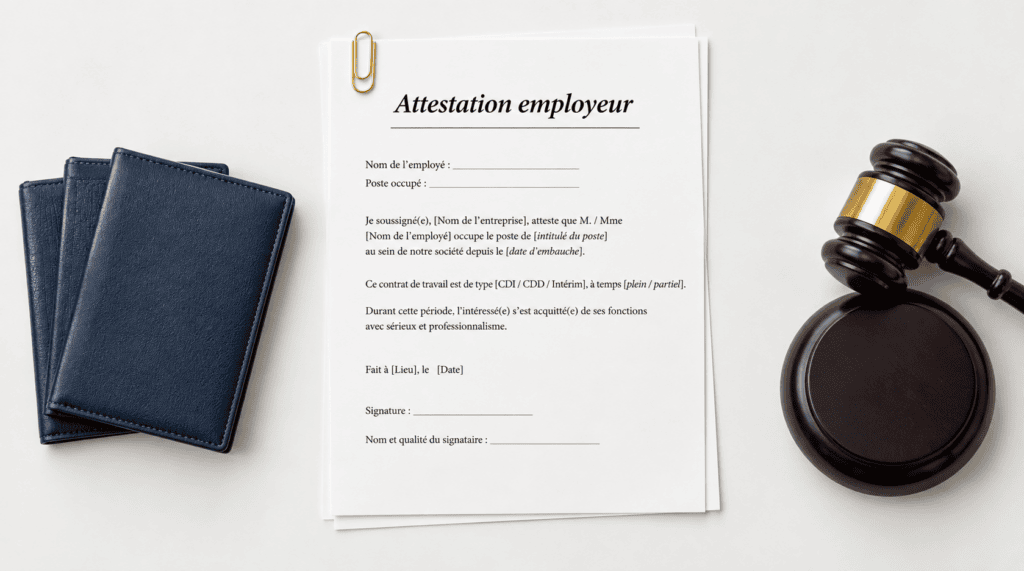
The certificate of employment is an essential document for the employee. It notably allows them to prove their professional experience and the positions they have held to a new employer.
Its content is strictly governed by Article D. 1234-6 of the Labor Code. In 2026, it must notably mention the employee’s start and end dates, as well as the nature of the job or jobs successively held and the corresponding periods.
The employer must therefore ensure that a compliant certificate is issued and provided to the employee at the end of the contractual relationship.
This obligation applies to various situations in which the contract ends, including the expiration of a fixed-term contract, dismissal, resignation, or a mutual termination agreement.
The certificate of employment must not be confused with the employment contract or pay stubs. It is a specific document, issued precisely at the end of the employment relationship.
The Employer’s Certificate for France Travail
The former designation “Pôle emploi certificate” or “unemployment insurance certificate” may still be encountered in some judicial decisions or older documents. In 2026, it is preferable to use the expression “employer’s certificate for France Travail”.
This certificate allows the employee to assert their rights under the unemployment insurance scheme. France Travail reminds that the employer must send this certificate to their former employee and to France Travail at the end of the contract.
The certificate notably contains information relating to the contract, its termination, wages paid, and any indemnities. These elements are essential for France Travail to examine the job seeker’s situation.
The employer must therefore be particularly vigilant when preparing it. An error or omission can lead to difficulties in assessing the employee’s rights and necessitate a corrective certificate.
Transmission to France Travail is now largely dematerialized
For several years, the formalities related to the employer’s certificate have been largely dematerialized. In 2026, employers subject to DSN notably transmit information related to the end of the contract via an FCTU – Unique Employment Contract Termination notification.
France Travail specifies that for each contract termination, employers subject to DSN transmit the employer’s certificate to France Travail through this channel, via their payroll software and the appropriate platform. In case of technical impossibility, a dematerialized entry can notably be made from the France Travail employer area.
Article R. 1234-9 of the Labor Code also stipulates that employers of at least eleven employees must perform this transmission electronically, unless impossibility results from a cause beyond their control. These provisions have been in effect since July 1, 2024.
However, dematerialization does not mean that the employee should be deprived of their copy. The employer must also provide them with the certificate intended for France Travail.
What happens when the employer provides documents late?
This was precisely the question at the heart of the ruling issued by the Court of Cassation on February 19, 2014.
In this case, an employee had been employed under a fixed-term contract that ended on July 5, 2009. She had brought a claim before the labor court, notably to obtain her certificate of employment and her unemployment insurance certificate.
The employer finally sent her these documents only on August 11, 2009, more than a month after the end of her contract. The employee then sought damages due to this delayed provision and her employer’s resistance.
The labor court had rejected her claim. However, the Court of Cassation overturned this decision. It reiterated that the certificate of employment and the unemployment insurance certificate were due upon contract expiration and that their delayed provision necessarily caused the employee damages.
This decision therefore highlights the importance of the employer’s compliance with their obligations at the time of contract termination.
Case law on damages must, however, be assessed with caution
The wording of the 2014 ruling, however, deserves to be put back into context.
The Court of Cassation had then affirmed that the delayed provision of documents necessary for the exact determination of the employee’s rights necessarily caused them damages. This wording should not lead one to believe that in 2026, any delayed provision automatically entails the payment of compensation, regardless of the circumstances.
More recent case law indeed calls for a concrete assessment of the existence and extent of the alleged damages in certain situations. Decisions rendered in recent years have thus dismissed claims for compensation when the employee did not sufficiently demonstrate the damages resulting from the delay or when the circumstances did not allow for characterizing compensable harm.
For an employee facing delayed provision, it is therefore useful to keep all elements demonstrating the consequences of the delay: difficulties encountered with France Travail, delay in the payment of benefits, inability to quickly prove professional experience, additional steps taken with the employer, or any other element establishing the reality of the damages.
What recourse in case of unprovided end-of-contract documents?
When an employer does not provide end-of-contract documents within the deadlines, the employee can first send a formal request for regularization. A written formal notice allows for retaining proof of the steps taken and reminding the employer of their obligations.
In the absence of regularization, a claim before the labor court may be considered to obtain the provision of documents, possibly under penalty payment, and, when the conditions are met, compensation for the damages suffered.
The employee can notably request that the certificate of employment and the employer’s certificate for France Travail be provided or rectified if they are absent, incomplete, or erroneous.
The delay can also expose the employer to penalties. France Travail indicates that non-compliance with obligations relating to the employer’s certificate can notably result in a fine of up to €1,500, in accordance with the provisions of the Labor Code.
Should the employee wait for their certificate to register with France Travail?
The absence of an employer’s certificate does not necessarily mean that the employee must wait before taking steps with France Travail.
It is in the employee’s interest to promptly initiate their procedures as soon as their contract ends, without systematically waiting for all documents to be provided. The certificate can then be transmitted or regularized when necessary.
This distinction is important: the employer’s obligation to provide the certificate remains in full, but the employee should not necessarily delay all their procedures due to an employer’s failure.
What to remember from the February 19, 2014 ruling in 2026?
The ruling Cass. soc., February 19, 2014, no. 12-20.591 remains an important decision concerning the delayed provision of end-of-contract documents. The Court of Cassation had clearly reiterated that the certificate of employment and the unemployment insurance certificate were due upon contract expiration and that their delayed provision could engage the employer’s liability.
In 2026, the fundamental principles remain applicable. Article L. 1234-19 still mandates the issuance of the certificate of employment upon contract expiration. Article R. 1234-9, for its part, mandates the provision to the employee of the certificates necessary for the exercise of their rights and their transmission to France Travail without delay.
The main evolution lies in the practical modalities: the former “Pôle emploi” certificate is now an employer’s certificate for France Travail, and its transmission is largely dematerialized.
For the employer, compliance with these formalities is therefore essential to secure the termination of the employment contract. For the employee, a delay, absence, or error in these documents may justify a request for regularization and, depending on the circumstances, an action before the labor court.
Cabinet CARREZ assists employees and employers with issues related to employment contract termination, employer obligations, and disputes that may be submitted to the labor court.